

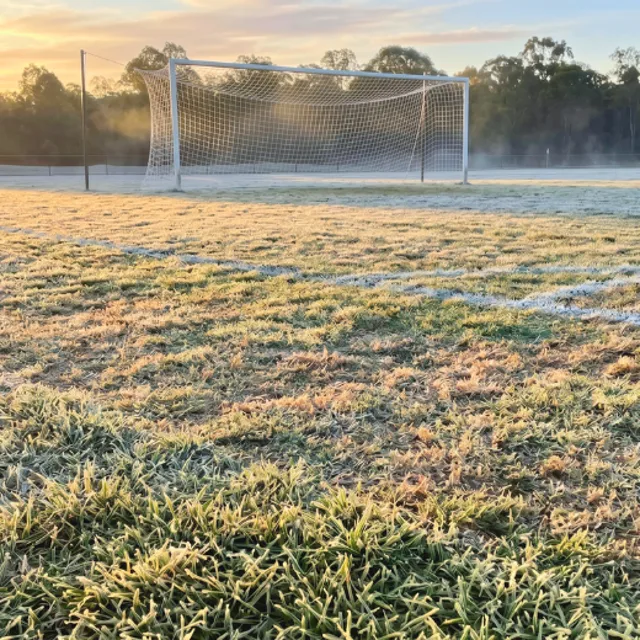
Your turf has not stopped recovering. It has stopped being able to.
By mid-winter, most sports fields and fine turf surfaces have hit the same wall. Divots from Saturday are still open the following weekend. Frosted corners stay grey for days. Disease scars from a cold, damp week are not healing, and weeds are filling the gaps your turf is too slow to close. You are doing everything right and the surface still looks like it is going backwards.
This is not a maintenance failure. It is physiology. Once you understand why cold shuts turf recovery down at the cellular level, you can stop fighting the season and start managing it. Here is what is actually happening, and what you can do about it right now.
Why turf recovery stalls in winter
Two things collapse in winter, and they compound each other.
The first is temperature. Australia's most common surfaces are warm-season grasses: couch, kikuyu and buffalo. These species are built for heat and slow dramatically as soil cools. Below roughly 14 degrees Celsius of soil temperature, warm-season turf growth becomes minimal and the plant pulls energy down into the crown and roots. It is not dead. It is conserving. But turf that is not actively growing cannot repair wear, fill divots or out-compete invading weeds at anything near its summer rate.
The second is light. Shorter days and a lower sun angle mean less light energy reaching the canopy for photosynthesis. Shaded corners, the southern side of a ground and areas under stands get even less. Less light means less sugar production, which means less energy for the metabolic work of recovery, exactly when cold is already suppressing it.
Layer the acute stressors on top of that baseline, frost events, cold winds, wear on saturated surfaces and higher disease pressure in cool damp conditions, and you have turf being challenged hard while its recovery systems are throttled right down. You can track frost risk for your region through the Bureau of Meteorology and plan traffic and renovation around it.
What is salicylic acid, and how does it work in turf?
Salicylic acid (SA) is a naturally occurring phenolic compound that plants produce themselves in response to stress and pathogen attack. It is one of the plant kingdom's core stress-signalling molecules. When part of a plant is challenged, SA accumulates and switches on a coordinated, whole-plant defence response called Systemic Acquired Resistance (SAR).
In practical terms it does several things at once. It triggers production of pathogenesis-related proteins and other antimicrobial compounds, it helps wall off infected tissue to limit disease spread, and it primes the rest of the plant so cells respond faster to the next stress event. Peer-reviewed research shows SA pre-activates plant defence mechanisms before stress fully takes hold, producing a faster, stronger response when the stressor arrives, and that applied SA improves tolerance to a broad range of abiotic stresses including chilling, drought and heat. The established science on SAR confirms SA as the key signalling molecule behind that whole-plant immune response.
The simplest way to think about it: applying SA gives the plant a head start on a stress response it would otherwise only mount after the damage had begun. It is closer to priming the immune system ahead of the challenge than to feeding the plant.
The stress types salicylic acid helps with
- Cold and chilling stress. SA is documented as contributing to chilling tolerance, which is the reason it belongs in a winter program and not only a summer one.
- Disease pressure. By triggering SAR, SA reduces the severity of secondary infection, which matters in the cool, damp conditions that favour turf pathogens.
- Drought and water stress. SA improves stomatal regulation and reduces water loss, relevant in dry, windy winter spells and on free-draining sand profiles.
- Wear and recovery. SA supports faster cell repair and root development, the function cold otherwise suppresses.
- UV and light intensity. SA offers indirect support through improved cellular integrity.
One honest caveat, because a technical audience deserves one. Much of the foundational SA research has been done on model species and crops rather than warm-season turf specifically. The mechanisms are well-established plant physiology being applied to turf, not a large body of warm-season field trials. Treat SA as a resilience and priming tool, not a guaranteed growth response.
The mid-winter rule: mitigate stress, do not force growth
This is where most winter turf advice goes wrong. You cannot fertilise a dormant warm-season sward back into active growth in the middle of winter, and trying to with heavy nitrogen invites soft growth and disease. In true dormancy the goal is not to force recovery. It is to mitigate stress, protect the plant and hold colour until rising soil temperatures let the turf wake up on its own.
That reframes the whole job into three moves: prime the plant's own stress tolerance, maintain colour without forcing a flush of growth, and avoid adding stress. The product logic below follows that order.
1. Prime stress tolerance with salicylic acid
FloraFert Recover Pro 4.2-12-22.5 carries 0.5% salicylic acid alongside 5% microbial metabolites. The salicylic acid is the stress-priming component, helping the plant activate its own defence and tolerance pathways ahead of cold and disease events rather than after them. Its place in winter is on turf that is still semi-active, coastal Queensland surfaces, milder microclimates and cool-season swards, where there is enough plant activity for a priming response to mean something. On fully dormant inland couch in a hard frost pocket, the emphasis shifts to the colour and protection moves below.
2. Hold colour without forcing growth, using iron
FloraFert Micro Total 5-0-0 +6% Fe +TE is iron-led with a full trace element package and almost no nitrogen. That profile suits winter precisely because iron supports colour and chlorophyll function without driving the leaf growth nitrogen would. When you need a surface to stay green and healthy through the cold without pushing soft, disease-prone growth, iron and trace elements do the colour work nitrogen should not be asked to do in winter.
3. Restore instant colour on dormant turf with pigment
Colour King is a natural pigment-based colourant that instantly restores colour to faded or dormant grass. It is not purely cosmetic: a darker pigmented canopy absorbs more light, which can lift canopy temperature, and pigments offer some UV protection. Colour King can be used year round, with higher rates as turf moves through dormancy, in the order of 900 to 2400 mL per hectare for early dormancy and 2400 to 4800 mL per hectare for full dormancy. It is the right tool when a ground has to present well for winter fixtures while the plant itself stays in conservation mode.
Browse the full turf fertiliser range to match products to your program.
What to avoid in winter
- Do not apply heavy nitrogen to dormant warm-season turf. It forces soft growth the plant cannot support and raises disease risk.
- Do not traffic or mow frosted surfaces. Frozen leaf tissue fractures under load, turning a cosmetic frost into physical damage.
- Do not scalp. A slightly higher cut leaves more leaf area for what limited photosynthesis the short days allow.
- Do not assume dormant means dead. A grey, slow surface is conserving energy in the crown and roots and will recover when soil warms, provided you have not damaged it first.
Where this sits in your seasonal program
Winter stress mitigation is the middle chapter of a year-round story. Through the hot months the priority is heat, moisture and wear, covered in the Summer Turf Survival Guide. Through winter it shifts to the cold-stress approach set out here. And the better you protect the plant now, the smaller the repair bill in spring, which is exactly what the Spring Turf Rehab guide is built to address. Winter mitigation is, in large part, spring rehabilitation you do not have to pay for later.
For the soil and root resilience underneath all of this, the role of microbial inputs is covered in Why Every Professional Turf Program in Australia Needs a Biostimulant Stack, which is relevant because Recover Pro's microbial metabolites sit in that same conversation.
Frequently asked questions
Does salicylic acid work in cold weather, or only for summer heat stress?
Salicylic acid is documented as contributing to chilling and cold tolerance, not only heat tolerance. It works as a stress-priming signal across multiple stress types, which is why it has a legitimate place in a winter program, particularly on turf that is still semi-active.
Should I fertilise warm-season turf in the middle of winter?
Not with nitrogen aimed at forcing growth. Dormant warm-season turf cannot use it and may respond with soft, disease-prone growth. An iron-led, low-nitrogen approach maintains colour and health without forcing a growth flush the season cannot support.
Is a turf pigment just cosmetic?
Colour is the main benefit, but it is not purely cosmetic. A darker pigmented canopy absorbs more light, which can raise canopy temperature, and pigments can provide some UV protection, so there is a physical effect alongside the visual one.
My turf has gone grey and stopped growing. Is it dying?
Almost certainly not. Warm-season grasses conserve energy in the crown and roots over winter and lose colour and growth at the surface. This is dormancy, a protective mechanism, and the turf will recover as soil warms, provided it has not been physically damaged or pushed into disease.
Talk to Fernland about your winter program
Every site is different. A frost-prone inland oval needs a different approach to a mild coastal golf surface. Fernland's turf range covers the stress-mitigation, colour and protection products above, and our team can help you match an approach to your site, soil and surface. Explore the Turf Care range, or for a tailored assessment look into our Turf Care Diagnostic and Analysis Services. For advice, call the team on 1800 672 794.