

Sphagnum peat has been a fixture in nursery growing media for decades. Its water-holding capacity, low bulk density, and predictable pH made it the reliable default for plug production, tubestock, and container growing across Australia and globally. That position is now shifting. Not because peat performs poorly, but because the case for depending on it as a primary substrate input is becoming harder to sustain across a production nursery's cost structure and supply chain.
The Pressure Building on Peat-Based Growing Media
Three factors are converging on Australian production nurseries at once.
Supply chain exposure. Australia does not produce sphagnum peat at commercial scale. The product is imported, primarily from the Northern Hemisphere, which means lead times, freight costs, and availability are all subject to variables outside a nursery's control. Currency fluctuations and international shipping variability have made this exposure more visible in recent years.
Input cost. Peat pricing has risen in line with global demand and transport costs. For nurseries running large-scale container production, the cost per litre of growing media matters. Where peat was once cost-competitive, that margin has narrowed considerably against locally sourced coir alternatives available through the Asia-Pacific supply chain.
Sustainability pressure from the supply chain. The Australian nursery sector reached $2.8 billion in production value in 2024/25, up 4% on the previous year, and retail buyers are increasingly asking questions about sustainable production inputs. Peat harvesting draws on bog ecosystems that store significant quantities of carbon and take centuries to regenerate. Nurseries that depend heavily on peat are starting to hear these questions from their own customers.
What Made Sphagnum Peat the Default
Peat has genuine agronomic advantages that explain why it became the industry standard. Its cation exchange capacity (CEC) is high, meaning it holds nutrients effectively and buffers against deficiencies between fertigation events. Its pH sits naturally in the acidic range preferred by many ornamental crops. Its physical structure creates predictable water-holding and aeration properties in container media that have given growers consistent, repeatable results across decades of production.
It is worth saying plainly: in certain applications, particularly orchid production and some specialist propagation work, high-quality sphagnum peat still has a role. This is not an argument for eliminating peat from every nursery program. It is a case for reducing dependency where the agronomic justification does not specifically demand it, which covers a large proportion of standard production nursery applications.
Why Coir Is Now the Leading Alternative for Australian Production Nurseries
Technical Performance Advantage
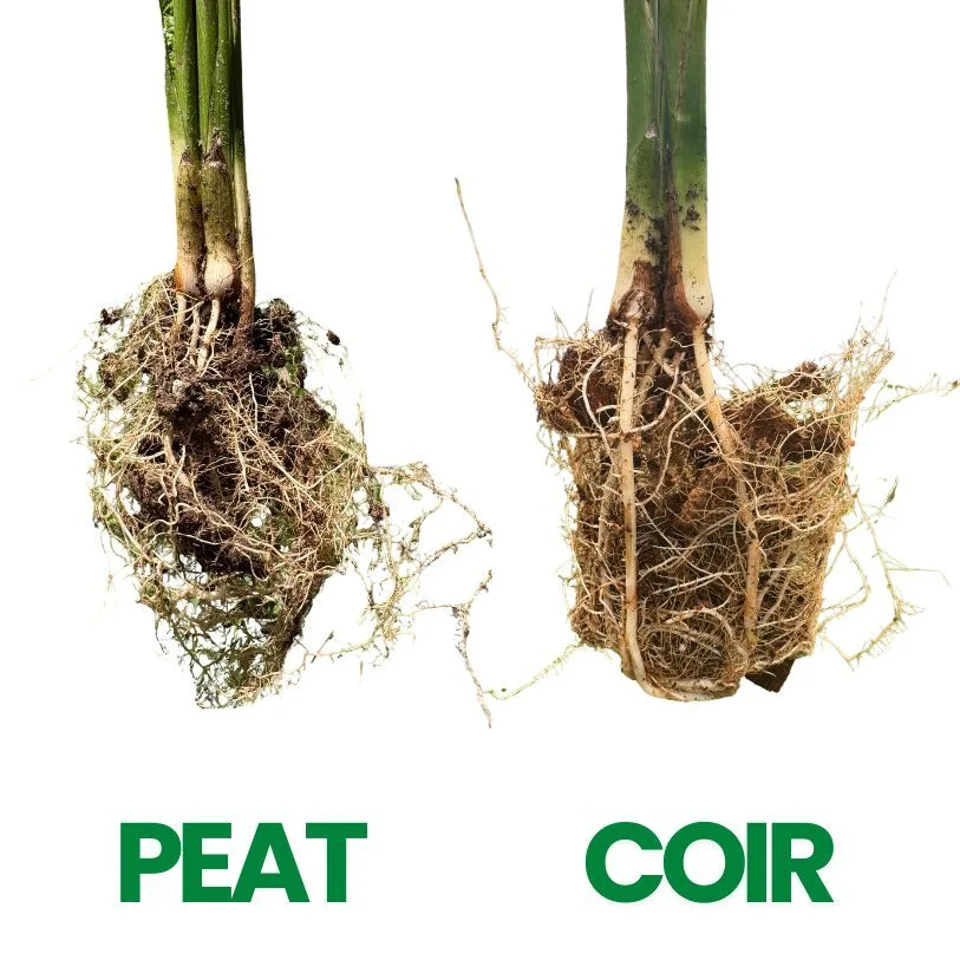
Similar root ball sizes, but over 50% more root mass in the coir grown palm.
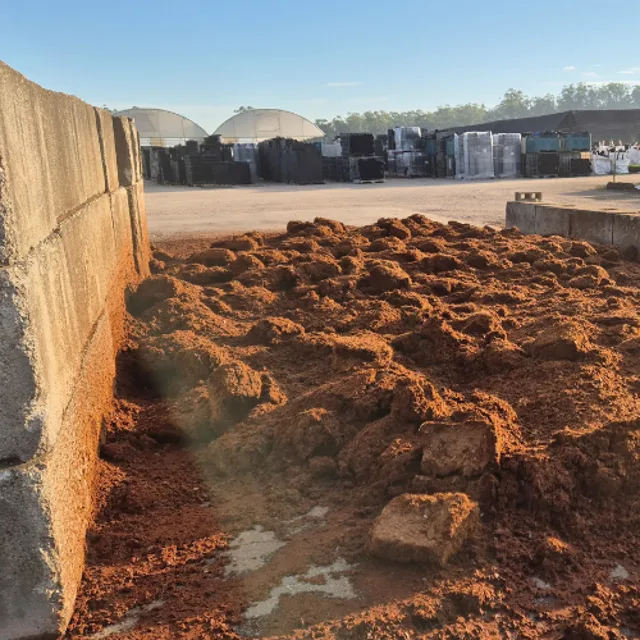
Cocopeat (coir pith) is the fine, spongy material extracted from the husk of coconuts during fibre processing. Unlike peat, it is a renewable by-product of an existing agricultural industry, not a material extracted from protected ecosystems. Production is concentrated in Sri Lanka, India, and South-East Asia, meaning supply into the Australian market is reliable, the supply chain is shorter than for Northern Hemisphere peat, and the product is available in the volumes that production nurseries require.
A peer-reviewed review published in Frontiers in Horticulture in October 2025 confirms coir as the most widely adopted peat alternative in container-based horticulture globally. The shift in Australian production nurseries reflects the same trajectory.
Its physical properties make it a strong performer across most container production scenarios:
- Water retention: coir holds up to eight times its weight in water and rewets easily after drying. This is a significant practical advantage over peat, which can become hydrophobic once dried and is difficult to rehydrate uniformly.
- pH: coir sits at approximately 5.5 to 6.5, close to neutral, compared to the more acidic 3.5 to 5.5 range typical of sphagnum peat. This often reduces or eliminates the lime additions that peat-based blends require.
- Structural longevity: coir degrades more slowly than bark and maintains its structure over a longer production cycle, reducing the risk of media collapse in longer-turn crops.
- Pathogen resistance: Quality-washed coir is sterile and pathogen-free, reducing disease pressure in propagation and seedling production.
What to Manage Differently When You Switch from Peat to Coir
The transition is not complicated, but it requires adjusting a few parameters before you achieve the consistency your production program demands.
EC management. Raw coir can contain elevated sodium and potassium levels if it has not been properly washed during processing. Quality coir for nursery production should have an EC below 1 mS/cm at a 1:1.5 dilution. GrowRite coir is produced to this specification. If you are sourcing coir from an unfamiliar supplier, always request EC data before incorporating it into a blend.
Nutrition program. Coir has a lower CEC than sphagnum peat, which means it buffers nutrients less effectively between fertigation events. Nurseries switching from peat should review their fertiliser program alongside the substrate change. Slow-release fertiliser incorporation and regular EC monitoring of the growing media during production will ensure crops do not experience deficiencies that would not have appeared in a higher-CEC peat blend.
Blend ratios. Pure coir, while excellent for water retention, can reduce air-filled porosity in container media. Most production nurseries blend pith with coco chip or perlite to achieve the air-to-water ratio their crop requires. The right blend depends on crop type, container size, irrigation frequency, and climate.
Matching GrowRite Coir Format to Your Production Application
| Application | Recommended GrowRite Format | Key Characteristics |
|---|---|---|
| Plug and cell propagation, tubestock | Cocopeat Coir Pith Block (5kg) | Fine particle size, low EC, pathogen-free |
| Container pot plants, ornamentals | Coir Cocoblend 60/40 Optima | Balanced pith/chip blend, moisture retention |
| Orchids, aerophilic crops | Coir Cocochip Block | 100% chip, maximum air-filled porosity |
| High-volume production | Bale of Cocopeat Coir Pith (200L) | Cost-efficient bulk format |
| Hydroponic systems | GrowRite Maxi Grow Bags | Pre-made grow bags, UV-rated |
How to Trial Cocopeat at Scale Without Disrupting Production
The simplest approach for a nursery already running peat-based media is a parallel trial on a single crop line before committing to a full blend change. Choose a crop where you have good historical data on growth rate, water use, and fertiliser response. Run the trial line at your target coir blend alongside your existing peat blend and track EC, moisture, and crop performance at each production stage.
The Hort Innovation Nursery Strategic Investment Plan 2022-2026 identifies productivity and sustainability as core priorities for the sector. Moving to a more stable, renewable substrate input is aligned with both objectives.
Frequently Asked Questions
Is Coir a direct replacement for sphagnum peat in nursery growing media?
In most container production applications, yes. Coir performs comparably to peat in water retention, structural stability, and crop performance. The key differences to manage are EC, CEC, and air porosity.
What EC level should I look for when sourcing coir?
Target an EC below 1 mS/cm at a 1:1.5 dilution. All GrowRite coir products are produced to this specification. Always request EC data from any new supplier.
Can coir be used for seed raising and propagation?
Yes. The fine particle size and sterile, pathogen-free nature of quality coir makes it well-suited to seed raising, plug production, and early propagation work.
How do I manage nutrition when switching from peat to cocopeat?
Cocopeat's lower CEC means it holds fewer nutrient ions than sphagnum peat. Review your slow-release fertiliser rates at the point of blend formulation and monitor media EC during production.
Talk to the Fernland Team
The full GrowRite coir range is available at Fernland in wholesale quantities. If you are working through a substrate change, contact the Fernland team directly. We have been supplying Australian production nurseries since 1978 and can help you work through the blend and trial approach that suits your operation.