
Why Every Professional Turf Program in Australia Needs a Biostimulant Stack
Posted by Jason on 18th Feb 2026
The fertiliser is doing less work than you think
If your turf program runs on fertiliser, irrigation, and reactive fungicide applications — you're managing symptoms. The soil underneath is the real production engine, and in most Australian turf situations, it's running below capacity.
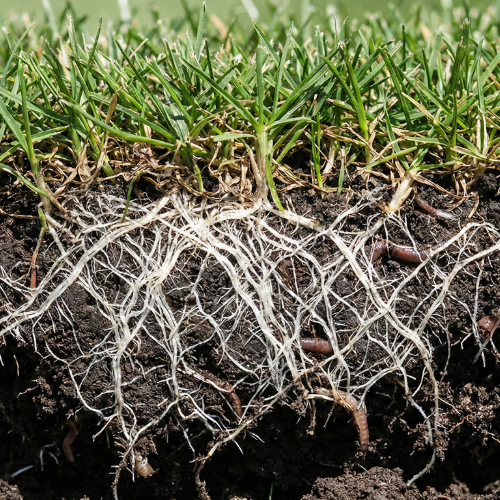
Compacted profiles, depleted microbial populations, and locked-up phosphorus don't show up on a colour chart. But they show up in recovery times after wear, in uneven spring green-up, and in the volume of nutrition you're putting in versus the response you're getting back.
That's where a biostimulant program changes the equation.
What biostimulants actually do in a turf context
Biostimulants are products that stimulate plant processes — nutrient uptake, root development, stress tolerance — without replacing fertilisers. They're built from compounds like seaweed extracts, humic acids, amino acids, and microbial metabolites, and their job is to make the rest of your program work harder.
Two products sit at the core of Fernland's turf biostimulant program:
FloraTech Stimulate is a live microbial soil activator containing 12 million Colony Forming Units per mL across four bacterial strains: Pseudomonas fluorescens, Bacillus licheniformis, Bacillus amyloliquefaciens, and Bacillus mucilaginosus. Applied to the soil, these strains multiply rapidly — accelerating the existing microbial population by 8–10 times under good conditions. That explosion of biology drives phosphorus and potassium mineralisation, improves soil aeration through CO2 production, and actively antagonises soil-borne pathogens like Rhizoctonia and Phytophthora.
FloraTech Rejuvenate is the organic support layer — seaweed extract (10%), humate (7%), microbial metabolites (5%), B-group vitamins, amino acids, and chelated iron, all formulated to promote root vigour and improve the soil environment that Stimulate's biology lives in. Think of Rejuvenate as the food and structure; Stimulate is the workforce.
Used together, they're complementary inputs targeting the same outcome: a root zone that responds, recovers, and performs.
In controlled nursery trials, Stimulate and Rejuvenate delivered a 47% increase in plant mass, a 32% increase in root mass, and a 28% increase in plant height — results that reflect the same biological mechanisms at work in turf root zones.
The case for biology in Australian turf soils
Australian soils present specific challenges that make a microbial approach particularly valuable.
Phosphorus lock-up is endemic. Only 5–30% of the phosphorus applied as fertiliser is taken up by plants in the year of application — the rest rapidly reacts with iron, aluminium, and calcium in the soil to form compounds that are largely unavailable to roots. For turf managers applying high fertiliser volumes through the season, this represents a significant inefficiency in every application.
The Bacillus and Pseudomonas strains in Stimulate work directly on this problem. Both genera are among the most well-documented phosphate-solubilising bacteria in agricultural soils, producing organic acids that convert bound phosphorus and iron into plant-available forms directly in the root zone. The result is better nutrient availability from the same fertiliser program — without increasing rates.
Summer stress is severe. Queensland and northern Australian turf — Couch, Kikuyu, Zoysia — faces extreme heat load through December to February. Root systems retreat under sustained thermal stress, and turf that recovers quickly after heat events is turf with strong, deep root architecture maintained throughout the season. Research on warm-season bermudagrass published in HortScience found that seaweed extract-based biostimulants increased root biomass, root length, root surface area, and root viability compared to untreated controls under combined heat and drought stress conditions — which directly mirrors the challenge faced by turf managers in Australian summers. Rejuvenate's seaweed-derived growth hormones, saponins, and amino acids support these same physiological responses.
Wear and renovation demand faster recovery. Sports fields, golf courses, and council parks need to bounce back after events, aerification, and overseeding. The microbial population boost from Stimulate accelerates organic matter breakdown, improves soil structure post-aeration, and creates conditions for rapid re-establishment. Rejuvenate's rooting compounds support new root initiation during and after renovation work.
How to integrate Stimulate and Rejuvenate into a turf program
Seasonal base program
A practical starting point for turf managers targeting consistent performance across the season:
Apply Stimulate and Rejuvenate together as a soil drench or through fertigation every 4–6 weeks during the active growing season. The two products are compatible and can be tank-mixed, though checking compatibility with other products in the tank is standard practice.
Time the first application of the season ahead of peak growth — late August to September for warm-season turf in Queensland — to build up microbial populations before the heat and wear season arrives. A second application in January supports recovery through the hottest part of summer, and a third heading into autumn prepares root systems for the cooler months.
Renovation and establishment window
This is where the biostimulant program delivers its clearest return. Apply Rejuvenate through the core aeration or verticut process — directly into the holes where root regeneration will occur. Follow up with a Stimulate application within 48 hours to inoculate the disturbed soil zone with beneficial biology.
For overseed programs, a Rejuvenate drench at seeding and again at first mowing supports germination and early root development in the new stand.
Stress recovery protocol
After significant heat events, heavy traffic, or disease pressure, a targeted application of both products accelerates recovery. Rejuvenate provides the direct rooting stimulus; Stimulate re-establishes the soil biology that fungicide and heat events may have partially depleted.
Compatibility and application notes
Chlorinated water: Stimulate contains live microbes. Wherever possible, allow chlorinated irrigation water to off-gas before mixing, or use a tank separate from automated irrigation lines for application.
Copper-based fungicides: Keep a minimum five to seven-day buffer between copper applications and Stimulate applications. Copper is toxic to the microbial strains and will reduce the effective CFU count reaching the soil. Other systemic fungicides are generally fine with a 48-hour gap.
Fertigation compatibility: Both products integrate cleanly into fertigation systems and are compatible with most liquid fertiliser programs. They're not a replacement for NPK — they're a multiplier on what you're already applying.
Rate discipline: The products are formulated to specific rates for a reason. Over-applying Stimulate doesn't increase efficacy; the microbial population will self-regulate based on available substrate.
Who should be running a biostimulant program
The Australian Sports Turf Managers Association (ASTMA) represents over 1,500 professionals across golf courses, sports fields, racecourses, and recreation facilities — and biological soil health is consistently among the areas of greatest interest at their national conference and field days. If you're managing any of the following, the commercial case for Stimulate and Rejuvenate is straightforward:
Sports turf managers dealing with compaction, heavy wear schedules, and pressure to present quickly after events. The combination of improved soil structure and faster root regeneration directly shortens the recovery window.
Golf course superintendents managing presentation standards and fairway and green performance through summer. Microbial programs support consistent colour, tighter root architecture, and reduced disease pressure — particularly in greens where soil health is a chronic challenge.
Councils and parks maintenance teams operating on fixed input budgets. Better fertiliser efficiency from a microbial program means the same spend achieves more, or the same outcome can be achieved with a reduced fertiliser volume over time.
Turf producers and sod farms where speed to harvest and root mass at lift are direct commercial outcomes. Biostimulants in the production program reduce time to sale-weight and improve sod quality at the point of delivery.
Landscapers and revegetation contractors establishing turf on difficult or degraded soils where native biology is depleted and establishment risk is high.
Programme summary
| Application Window | Products | Method |
|---|---|---|
| Pre-season (Aug–Sept) | Stimulate + Rejuvenate | Soil drench / fertigation |
| Mid-summer (Jan) | Stimulate + Rejuvenate | Soil drench / fertigation |
| Post-aeration or overseed | Rejuvenate (Day 1), Stimulate (Day 2) | Direct application into aeration holes |
| Stress recovery | Stimulate + Rejuvenate | Soil drench |
| Late autumn (Apr–May) | Stimulate + Rejuvenate | Soil drench / fertigation |
Compliance
In Australia, biostimulant products are regulated by the APVMA and DAFF depending on their specific claims. Always ensure applications stay within plant- and soil-function claims rather than pest-control claims.
The bottom line
Every turf professional who has trialled FloraTech Stimulate and Rejuvenate through Fernland has gone on to incorporate both products into their ongoing program — a retention rate that, in our experience over 46 years of supplying the industry, is essentially unheard of.
Most turf programs are fertiliser-heavy and biology-light. In Australian soils — particularly in high-wear, high-heat environments — that imbalance limits what the fertiliser can actually do.
Adding FloraTech Stimulate and Rejuvenate into the program doesn't replace what you're already doing. It makes the root zone a more efficient environment for everything else to work in: better nutrient availability, stronger root architecture, faster recovery, and soil that builds biology instead of depleting it.
For turf managers who measure success in recovery speed, wear tolerance, and presentation consistency, the biology underneath the surface is where the gains are.
Explore the full FloraTech range at Fernland:
- FloraTech Stimulate — Advanced Microbial Soil Activator & Root Booster
- FloraTech Rejuvenate — Natural Rooting Substance & Biostimulant
- Browse all Fernland Turf Care products
For a customised biostimulant program for your turf operation, contact the Fernland team on 1800 672 794.