
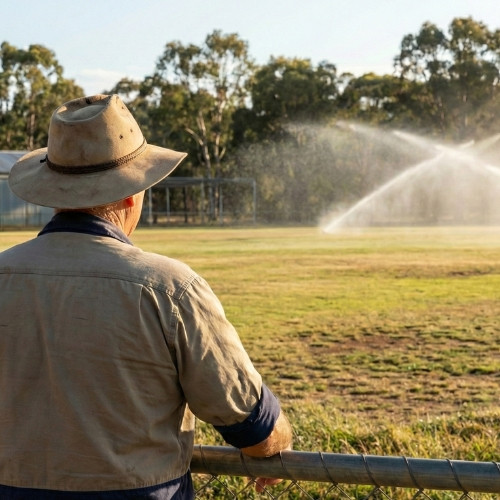
Summer Turf Survival Guide
Posted by Jason on 5th Jan 2026
The Australian summer presents unique challenges for turf managers and groundskeepers. With scorching temperatures, intense UV exposure, and unpredictable rainfall patterns, maintaining lush, healthy turf requires strategic planning and the right approach. This comprehensive guide covers essential practices to help your turf not only survive but thrive through the hottest months of the year.
Smart Watering Practices
Water management is the cornerstone of summer turf care. The key principle is deep, infrequent watering rather than frequent shallow irrigation. This approach encourages roots to grow deeper into the soil profile, creating a more drought-tolerant turf system that can access moisture reserves during heat stress periods.
Optimal Watering Timing
Early morning watering between 4am and 9am is critical for summer turf health. This timing minimises evaporation losses, allows foliage to dry before nightfall (reducing disease pressure), and ensures water reaches the root zone when plants are most receptive. Avoid evening watering, which leaves grass wet overnight and creates ideal conditions for fungal diseases.
PRO TIP: Aim for 25–40mm of water per week during peak summer, applied in 2–3 deep sessions rather than daily light watering. Use a rain gauge or tuna can to measure actual delivery to your turf.
Signs Your Turf Needs Water
- Footprints remain visible after walking across the lawn (turf doesn't spring back)
- Leaf blades begin to fold or curl inward
- Turf takes on a blue-grey tinge rather than vibrant green
- Soil probe or screwdriver meets resistance when inserted
Combating Hydrophobic Soil with Wetting Agents
One of the most common yet overlooked summer turf problems is hydrophobic soil—soil that repels water rather than absorbing it. This condition occurs when organic matter in the soil decomposes and coats soil particles with a waxy residue. The result? Water runs off or pools on the surface instead of penetrating to the root zone, leaving your turf stressed even when you're watering regularly.
How Wetting Agents Work
Soil wetting agents (surfactants) break down the waxy coating on soil particles, allowing water to penetrate evenly throughout the soil profile. They reduce surface tension, ensuring moisture reaches the root zone where it's needed most. For best results, apply wetting agents before the onset of summer heat and reapply every 4–8 weeks throughout the season.
Identifying Dry Patch Problems
Dry patches are telltale signs of water repellent soil. These localised areas remain brown and stressed while surrounding turf appears healthy. To test for hydrophobicity, place a drop of water on the soil surface—if it beads up and sits on top rather than soaking in within 5 seconds, you have water repellent soil that will benefit from wetting agent treatment.
FERNLAND SOLUTION: Our professional-grade wetting agents are specifically formulated for Australian conditions. They provide long-lasting soil penetration and are compatible with all turf varieties commonly used across sports fields, golf courses, and commercial landscapes.
Managing Heat Stress: What to Avoid
When temperatures climb above 30°C, turf enters survival mode. During these extreme conditions, certain maintenance activities can cause more harm than good. Understanding what not to do is just as important as knowing the right practices.
Avoid Fertilising in Extreme Heat
Applying fertiliser during heat waves (temperatures exceeding 30°C) can severely damage your turf. High nitrogen fertilisers stimulate top growth when the plant should be conserving energy, and salt-based fertilisers can burn roots already stressed by heat and dry conditions. If fertilisation is necessary, opt for slow-release formulations applied in the early morning or wait for cooler conditions.
Monitor the Bureau of Meteorology's heatwave forecast to plan your maintenance schedule around extreme heat events.
Raise Your Mowing Height
During summer, raise your mowing height by 25–50% compared to cooler months. Taller grass shades the soil, reducing moisture loss and keeping root zones cooler. Avoid mowing during the hottest part of the day (typically 11am–4pm), as this compounds stress on the plant. Early morning mowing, after dew has dried, is ideal.
Critical temperature thresholds for common Australian turf varieties:
- Couch grass: Reduce maintenance above 32°C
- Buffalo grass: Reduce maintenance above 30°C
- Kikuyu: More heat tolerant, but reduce maintenance above 35°C
Moisture-Retentive Amendments
Beyond wetting agents, incorporating moisture-retentive amendments into your soil profile can significantly improve summer turf performance. These products hold water in the root zone, releasing it gradually as the soil dries, extending the effective period between irrigation cycles.
Key Amendment Types
- Hydrogels and water crystals: Absorb up to 400 times their weight in water and release it slowly to plant roots
- Organic matter amendments: Improve soil structure and water-holding capacity naturally
- Zeolites: Mineral-based amendments that retain both moisture and nutrients
- Biochar: Improves soil water retention while enhancing microbial activity
Efficient Irrigation Systems
The right irrigation equipment makes all the difference in summer water management. Inefficient sprinklers waste water through misting and uneven coverage, while well-designed systems deliver water precisely where it's needed with minimal loss.
Sprinkler Selection Guidelines
- Choose low-angle sprinkler heads to reduce wind drift and evaporation
- Ensure head-to-head coverage for uniform water distribution
- Consider pressure-regulated heads to maintain consistent output
- Use matched precipitation rate nozzles across zones
FERNLAND SOLUTION: Our range of efficient sprinklers and irrigation accessories are designed for Australian conditions, helping you achieve optimal coverage while minimising water waste. Contact our team for a site assessment and system recommendations tailored to your facility.
Your Summer Turf Survival Checklist
- Water deeply and infrequently—early morning is best
- Apply wetting agents to combat hydrophobic soil and dry patches
- Avoid fertilising when temperatures exceed 30°C
- Raise mowing height and avoid mowing during peak heat
- Consider moisture-retentive amendments for high-stress areas
- Audit irrigation systems for efficiency and coverage
- Monitor turf daily for signs of stress and respond quickly
Partner with Fernland This Summer
At Fernland, we understand the unique challenges Australian turf managers face during summer. Our comprehensive range of wetting agents, moisture-retentive products, and efficient irrigation solutions are designed to help you maintain pristine turf even in the harshest conditions. Contact our turf care specialists today to discuss your summer management strategy and discover how our products can make a difference for your facility.
For product enquiries and expert advice, visit www.fernland.com.au/contact-us or call our team on 1800 672 794.