

Nursery Summer Management Checklist: Irrigation, Pests & Weeds
Posted by Jason on 17th Dec 2025
Australian summers place extreme pressure on wholesale nurseries. Extended heatwaves, high evaporation rates, and reduced staffing levels can quickly turn minor issues into catastrophic stock losses.
This Nursery Summer Management Checklist outlines the essential, preventative agronomic practices required to protect nursery stock during peak summer conditions. Based on advice from Fernland Agronomist Patrick Gorman, this guide focuses on four non-negotiable pillars of summer nursery success:
-
Soil wetting agents
-
Pre-emergent weed control
-
Summer pest management
-
Irrigation system auditing
Used together, these strategies reduce water stress, suppress weeds, prevent pest outbreaks, and safeguard irrigation reliability when temperatures exceed 35°C.
Quick Summer Nursery Checklist
| Risk Area | Summer Action |
|---|---|
| Hydrophobic potting media | Apply residual soil wetting agent before peak heat |
| Weed pressure | Apply pre-emergent herbicide to create chemical barrier |
| Spider mites & whitefly | Preventative miticide rotation early summer |
| Irrigation failure | Full irrigation audit before heatwaves and end of year break |
1. Treating Hydrophobic Soil in Potting Media
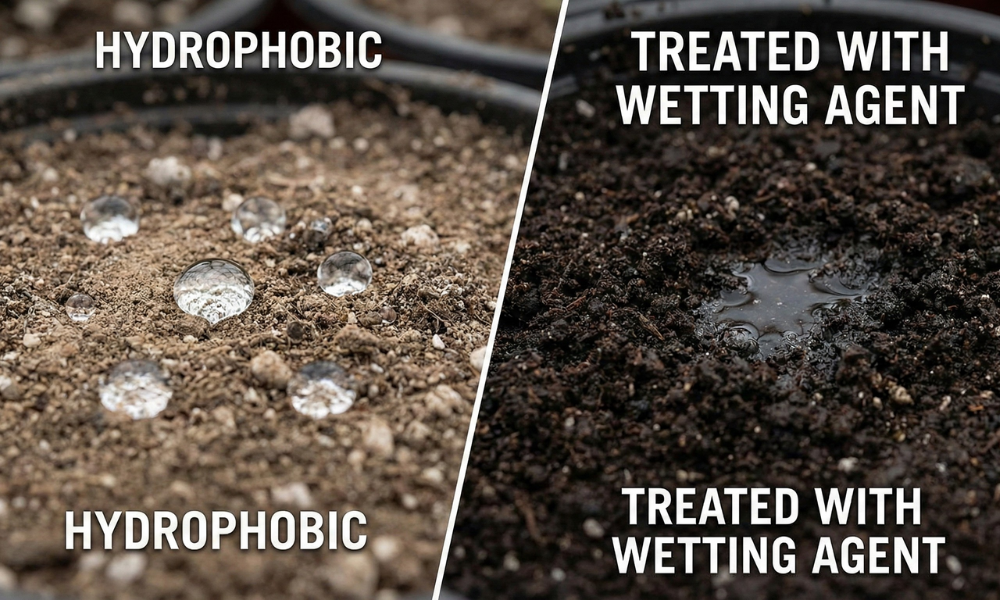
One of the most common causes of plant death in summer is not a lack of irrigation, but poor water penetration into potting media.
Rapid drying cycles often cause potting mix to become hydrophobic (water-repellent), and water repellent soils are a well-documented issue in Australian production environments where water can fail to infiltrate evenly into the root zone. This leads to uneven moisture, root stress, and sudden crop collapse during heat events.
Best Practice: Apply a Residual Soil Wetting Agent
Applying a long-term, residual nursery soil wetting agent before summer is critical. This ensures:
-
Uniform water distribution throughout the pot
-
Improved irrigation efficiency during high evaporation
-
Reduced hand-watering when staffing is limited
-
Protection against missed irrigation cycles
Product Recommendation:
Fernland recommends Aquaflo® or AquaFix®, both designed specifically for horticultural production systems and proven to maintain media wettability under extreme summer conditions.
Check out our full range of Soil Wetting Agents for Nurseries.
2. Summer Weed Control Using Pre-Emergent Herbicides

Warm temperatures combined with frequent irrigation create ideal conditions for rapid weed germination. In summer, weed growth accelerates dramatically, increasing labour costs and competition for water and nutrients.
Best Practice: Establish a Chemical Barrier Early
A pre-emergent herbicide program is the most cost-effective and reliable method of weed control during summer. Correctly applied, pre-emergents form a barrier that prevents weed seed germination for up to six months. Best-practice programs also use integrated weed management, combining sanitation and operational practices alongside herbicides to reduce long-term weed pressure
Application Protocol
-
Remove all existing weeds (pre-emergents do not control emerged weeds)
-
Apply evenly across the pot surface
-
Water in immediately to activate the barrier
Product Recommendation:
Industry-proven nursery options include Specticle®, Barricade®, and FreeHand®. Always check product labels for crop safety and application timing.
Shop our full Pre-emergent Herbicides Range.
3. Summer Pest Control: Two-Spotted Mite & Whitefly

High temperatures and low humidity create perfect breeding conditions for Two-Spotted Mite (Spider Mite) and whitefly. During summer, mite populations can escalate from undetectable to damaging within 7–10 days.
Best Practice: Preventative “Clean-Up” Spray Program
Waiting for visible damage is too late. Summer pest management must be preventative. For growers, plant health, pests and diseases guidance from Queensland DPI reinforces the value of early detection and timely intervention when pest pressure rises in warm conditions.
Key Actions
-
Scout early on susceptible indicator plants
-
Apply a miticide with residual activity
-
Target eggs, nymphs, and adults simultaneously
-
Rotate Mode of Action (MOA) groups to prevent resistance
If Group 10 or 21 chemistries were used in spring, rotate to a different MOA for summer applications.
Shop all Nursery Insecticide Products.
Click Here to shop our entire Nursery Chemicals & Plant Protection range.
4. Conducting a Nursery Irrigation Audit Before Summer
A single irrigation failure during a 35°C+ week can destroy an entire crop. While controllers are reliable, mechanical components often fail under sustained summer load.
Summer Irrigation Audit Checklist
-
Pressure Test: Measure pressure at the furthest point of the system
-
Uniformity Check: Look for dry “donuts” caused by blocked nozzles
-
Filter Cleaning: Flush disc and screen filters to remove algae buildup
-
Controller Battery: Replace backup batteries before storm season
Completing this audit before summer significantly reduces the risk of catastrophic system failure during heatwaves, as regular irrigation system checks and scheduling reviews are widely recommended in nursery production best practice.
While Fernland does not supply complete irrigation systems, we offer a comprehensive range of watering equipment solutions to support reliable, efficient water delivery across most nursery operations.
Shop Nursery Watering Equipment.
Frequently Asked Questions
When should I apply a soil wetting agent in nurseries?
Residual soil wetting agents should be applied before peak summer heat, ideally in late spring or early summer, to maintain media wettability during high-evaporation periods.
How long do pre-emergent herbicides last in nurseries?
Most nursery pre-emergent herbicides provide control for 3–6 months, depending on product choice, irrigation frequency, and potting media.
Why do spider mites increase in summer?
Spider mites thrive in hot, dry conditions. High temperatures accelerate their life cycle, allowing populations to explode rapidly during summer.
Can I apply wetting agents and pre-emergents together?
Yes, but compatibility and application timing should be confirmed. Always consult label instructions or a Fernland agronomist.
How often should irrigation systems be checked in summer?
At minimum, a full audit before summer and weekly visual checks during heatwaves are recommended.
Are these practices suitable for all nursery crops?
Most practices are broadly applicable, but crop-specific safety must always be confirmed. Fernland recommends tailored agronomic advice for mixed crop nurseries.
Summary: Preventative Investment Protects Summer Profitability
The cost of preventative inputs—a soil wetting agent, a pre-emergent herbicide, and a miticide—is minimal compared to the cost of dumping heat-stressed, unsaleable stock.
A proactive summer program improves irrigation efficiency, reduces labour pressure, protects crop quality, and ensures nursery resilience during extreme weather events. Prevention and early action are also consistent with national plant pest and disease biosecurity principles, where rapid response reduces the risk of widespread losses.
Need technical advice?
Contact the Fernland agronomy team for a tailored summer nursery management plan designed around your crops, systems, and regional conditions.