
Coir vs Jute for Erosion Control in Australia: How to Choose the Right Material for Your Project
Posted by Jason on 2nd Apr 2026
Jute products break down in 6 to 18 months depending on product type and conditions. Coir netting lasts 2 to 5 years. Both are 100% biodegradable, wildlife-safe, and classified as Rolled Erosion Control Products (RECPs) under IECA Australasia guidelines. The right choice depends on your slope grade, water exposure, project timeline, and budget. Jute is the more cost-effective option for moderate slopes where vegetation will establish within one growing season. Coir is the better choice for steep slopes, high-rainfall zones, waterway edges, and coastal sites where longer-term protection is needed before vegetation takes over. This guide covers the specs, applications, and GrowRite product options for each material so you can spec the right product for your next project.
Two Materials, Different Strengths
If you work in landscaping, revegetation, or civil construction in Australia, you have probably used both jute and coir at some point. Most contractors default to whichever they are familiar with or whichever is in stock. That works until you spec jute on a creek bank and it falls apart in six months, or you pay for coir on a gentle batter where jute would have done the job at half the cost.
Both materials are classified as RECPs under the IECA Australasia Best Practice Erosion and Sediment Control guidelines and are accepted by councils across Queensland and nationally for ESC plan compliance. The difference is in performance characteristics, service life, and cost per square metre.
Jute
Jute fibre comes from the stem of the jute plant. It is spun and either manufactured into a dense blanket, jute matting, or woven into an open cargo-net style mesh, jute soil saver netting. Jute absorbs water readily, which helps retain soil moisture and creates favourable conditions for seed germination and seedling establishment. It biodegrades within 10 to 18 months depending on climate, adding organic matter to the soil as it breaks down. In Queensland's subtropical conditions with higher rainfall and humidity, expect the shorter end of that range.
Coir
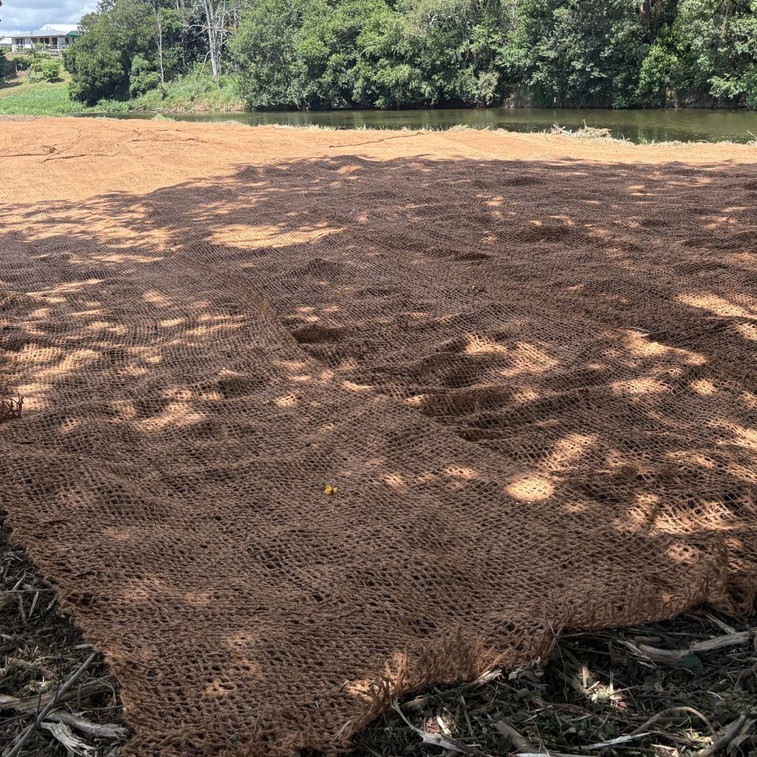
Coir fibre comes from the husk of coconuts. The critical difference is lignin content. Coir has significantly more lignin than jute, which makes the fibre naturally resistant to rot, saltwater, and UV degradation. That translates to a service life of 2 to 5 years depending on grade and conditions. Coir is woven into open diamond mesh netting or packed into dense fibre logs for waterway and bank stabilisation applications.
Specs Compared
| Factor | Jute | Coir |
|---|---|---|
| Source material | Jute plant fibre | Coconut husk fibre |
| Product forms | Non-woven blanket, matting, or open weave mesh, soil saver netting | Open weave diamond mesh, netting, or packed fibre logs |
| Typical lifespan | 6 to 18 months | 2 to 5 years |
| Tensile strength | Moderate | Higher, high lignin content |
| Wet performance | Absorbs water, accelerates breakdown in prolonged wet conditions | Naturally rot-resistant, maintains integrity in wet and coastal environments |
| Biodegradability | Fully biodegradable, faster breakdown | Fully biodegradable, slower breakdown |
| Relative cost | Lower per m² | Higher per m² |
| Wildlife safety | No entrapment risk, 100% natural fibre, no synthetic netting | No entrapment risk, 100% natural fibre, no synthetic netting |
Both materials are accepted in environmentally sensitive areas adjacent to bushland, wildlife corridors, and waterways where synthetic reinforced blankets with polypropylene netting would pose entrapment risks to reptiles and birds.
When to Use Jute
Jute is the right spec when vegetation is expected to establish within one growing season, the site does not have prolonged water exposure, and you need to cover a large area without blowing the erosion control line item in your quote.
| Product | GSM | Roll Size | Coverage | Lifespan | Best Applications | Max Slope |
|---|---|---|---|---|---|---|
| GrowRite Heavyweight Jute Matting, non-slitted | ~700 | 1.8m x 25m | 45m² per roll | 10 to 18 months | Weed suppression on embankments and batters, construction site perimeters, road shoulders | 2:1 |
| GrowRite Heavyweight Jute Matting, pre-slitted, 6 slits/m² | ~700 | 1.8m x 25m | 45m² per roll | 10 to 18 months | Revegetation planting with tube stock, bushcare and Landcare projects, creek bed restoration | 2:1 |
| GrowRite Jute Soil Saver Netting, open weave | N/A | 1.2m x 68m | ~82m² per roll | 6 to 12 months | Sand dunes, wind-exposed sites, broadcast seeding, mulch retention on steep batters | 3:1 |
Heavyweight Jute Matting
The dense, felt-like construction of GrowRite Heavyweight Jute Matting blocks light to suppress weeds while retaining soil moisture underneath. At approximately 700 GSM, it sits in the heavyweight category and handles foot traffic during installation and maintenance without tearing.
The pre-slitted option, approximately 6 slits per m², is where the real labour saving is on revegetation jobs. Without pre-cut slits, crews spend time cutting holes on site with knives on slopes, which slows installation and introduces safety issues. On a typical council revegetation contract covering 500m² or more, the time difference adds up quickly. That is roughly 11 rolls for 500m² of coverage.
Choose the non-slitted version when the goal is weed suppression or erosion protection without planting, for example along road batters, embankments, or construction site perimeters awaiting final stabilisation.
Jute Soil Saver Netting
GrowRite Jute Soil Saver Netting has an open weave structure that allows water, light, and air to pass through freely. This makes it the right product where natural revegetation is being encouraged rather than controlled planting. The open weave captures windblown soil and seed, making it effective on sand dunes and exposed coastal rehabilitation sites. It can also be laid over mulch on steep batters to hold the mulch in place during rain events.
Because of its open structure, jute netting provides less weed suppression than the heavyweight matting. Spec it when airflow and water infiltration are priorities over weed control. Each roll covers approximately 82m², which makes it efficient on large-area jobs.
When to Use Coir
Coir is the right spec when the site is wet, steep, coastal, or needs protection for longer than one growing season. If jute will break down before vegetation has established, step up to coir.
| Product | GSM | Roll/Unit Size | Coverage | Lifespan | Best Applications | Max Slope |
|---|---|---|---|---|---|---|
| GrowRite Coir Netting 400 GSM, 35mm diamond mesh | 400 | 2m x 25m | 50m² per roll | 2 to 3 years | Moderate slopes, general commercial landscaping, revegetation with tube stock | 2:1 |
| GrowRite Coir Netting 700 GSM, 20mm diamond mesh | 700 | 2m x 25m | 50m² per roll | 3 to 5 years | Steep slopes, high-rainfall zones, coastal sites, concentrated water flow areas | 1:1 |
| GrowRite Coir Fibre Erosion Control Logs | N/A | 1.5m x 200mm, 3m x 200mm, 3m x 300mm | Per unit, linear metre | 2 to 5 years | Creek banks, waterway stabilisation, sediment traps, shoreline protection, swale lining | Waterway edges |
Coir Netting: 400 vs 700 GSM
GrowRite Coir Netting comes in two grades. The 400 GSM option has a 35mm diamond mesh pattern, providing a cost-effective coir option for moderate slopes and commercial landscaping where you need longer protection than jute provides but the site is not extreme. The 700 GSM option has a tighter 20mm diamond mesh with greater tensile strength and soil retention for steep slopes, high-flow areas, and coastal applications.
The rule of thumb we use when advising customers is simple. If the slope is 2:1 or gentler and water flow is moderate, the 400 GSM will do the job. For anything steeper than 2:1, high-rainfall sites in South East Queensland and the tropics, or areas near waterways with concentrated flow, step up to the 700 GSM. Each roll covers 50m².
Coir Erosion Control Logs
GrowRite Coir Fibre Erosion Control Logs serve a different function to flat matting products. These are densely packed coconut fibre logs wrapped in coir netting, designed to be staked along creek banks, drainage lines, and shorelines. They slow water velocity, trap sediment, and create a stable structure for vegetation to establish along waterway edges.
The 200mm diameter logs suit lighter applications, garden drainage swales, low-flow roadside drains, and smaller revegetation projects. The 300mm diameter is for creek banks, river edges, and heavier water flow. Logs are secured with hardwood stakes driven through or adjacent to the log. For a 100m creek bank, you will need approximately 37 of the 3m logs, allowing for a 10% overlap at joints.
For large-scale projects requiring custom dimensions, pre-drilled staking holes, or plant holes, contact Fernland for project pricing and minimum order quantities.
Installation
Most of this will be familiar if you have installed erosion control products before. The principles are the same for both jute and coir.
Site preparation. Grade and smooth the surface. Remove rocks, debris, and vegetation that would prevent full contact between the matting and the soil. Complete any seeding before laying the matting.
Anchor at the top of the slope. Dig a shallow trench, approximately 150mm deep, across the top of the slope. Lay the leading edge of the matting into the trench, pin it, backfill and compact. This stops water running underneath the matting and lifting it.
Unroll downslope, in the direction of water flow. Maintain full contact with the soil surface. Do not bridge over dips or uneven ground.
Overlap adjacent rolls by 100 to 150mm. Shingle the upslope roll on top so water flows over the overlap rather than under it. Pin along the overlap.
Pin at 1 per m² across the body, closer at edges. Use GrowRite HD Hold-Down Pins, 4mm galvanised wire, at approximately 1 pin per square metre across the body of the matting, with closer spacing of every 300mm along edges, overlaps, and the anchor trench. The 150mm pins, 150mm x 50mm x 150mm, suit most soil types. Use the 300mm pins in sandy or loose soils where you need extra anchorage depth.
For site-specific installation design, refer to the IECA Australasia Erosion Control Blankets best practice document. In Queensland, erosion and sediment control on construction and development sites must comply with the Environmental Protection Act 1994 requirements administered by the Department of the Environment, Tourism, Science and Innovation and enforced by local councils.
Quick Selection Guide
| Site Condition | Recommended Product | Why |
|---|---|---|
| Revegetation planting on moderate slopes | GrowRite Heavyweight Jute Matting, pre-slitted | Weed suppression plus planting through pre-cut slits. Cost-effective at 45m² per roll. |
| Weed control on embankments, no planting required | GrowRite Heavyweight Jute Matting, non-slitted | Dense blanket blocks light, retains moisture, biodegrades after vegetation establishes. |
| Sand dunes, wind-exposed sites, broadcast seeding | GrowRite Jute Soil Saver Netting | Open weave captures windblown soil and seed. ~82m² per roll for large-area coverage. |
| Moderate slopes, commercial landscaping | GrowRite Coir Netting 400 GSM | Cost-effective coir option, 2 to 3 year service life, 50m² per roll. |
| Steep slopes, high-rainfall or coastal | GrowRite Coir Netting 700 GSM | Stronger, tighter 20mm mesh, 3 to 5 year service life for demanding sites. |
| Creek banks, waterways, shorelines | GrowRite Coir Erosion Control Logs | Stabilises banks, slows velocity, traps sediment. ~37 x 3m logs covers 100 linear metres. |
| Individual tree and shrub plantings | GrowRite Coconut Fibre Weed Control Mats | Per-plant weed suppression and moisture retention around new plantings. |
Frequently Asked Questions
What is the difference between coir and jute for erosion control?
Jute is a plant fibre that biodegrades in 6 to 18 months and is best for moderate slopes and short-term erosion control. Coir is made from coconut husk fibre with high lignin content, making it naturally rot-resistant with a lifespan of 2 to 5 years. Coir handles steeper slopes, wetter conditions, and coastal environments better than jute. Jute costs less per square metre, making it more cost-effective for large areas where vegetation will establish within one growing season.
How long does jute matting last for erosion control?
Heavyweight jute matting, approximately 700 GSM, typically lasts 10 to 18 months depending on climate, UV exposure, and soil moisture. Open weave jute soil saver netting has a shorter lifespan of 6 to 12 months. In subtropical climates like Queensland with higher rainfall and humidity, expect the shorter end of that range.
How long does coir netting last?
Coir netting typically lasts 2 to 5 years depending on the grade and site conditions. A 400 GSM coir mesh lasts approximately 2 to 3 years, while a heavier 700 GSM grade can last 3 to 5 years. Coir's high lignin content makes it naturally resistant to rot, saltwater, and UV degradation.
Can I use jute matting on steep slopes?
Heavyweight jute matting can be used on slopes up to 2:1, approximately 27 degrees. For slopes steeper than 2:1, coir netting is the better choice due to its higher tensile strength and longer lifespan. Open weave jute mesh is suited to gentler slopes of 3:1 or less. Always secure matting with hold-down pins and key the top edge into a trench for proper anchoring.
What is the best erosion control material for creek banks in Australia?
Coir products are the best choice for creek banks and waterway edges because of their rot resistance and durability in wet conditions. Coir fibre erosion control logs are specifically designed for bank stabilisation, slowing water velocity, and trapping sediment. For the banks above the waterline, coir netting, 700 GSM provides long-term slope protection. Jute is not recommended for areas with prolonged water contact as it degrades too quickly.
Are jute and coir erosion control products safe for wildlife?
Yes. Jute and coir erosion control products made from 100% natural fibres with no synthetic netting pose no entrapment risk to wildlife. This is a critical consideration near bushland, wildlife corridors, and waterways where councils and environmental management plans require wildlife-safe products. Synthetic reinforced blankets with polypropylene netting can trap lizards, snakes, and birds.
Browse the GrowRite Erosion Control Range
Fernland stocks the full GrowRite erosion control range including jute matting, jute soil saver netting, coir netting, coir logs, coconut fibre weed control mats, and hold-down pins. All products ship Australia-wide.
For trade pricing, project quantities, or help speccing the right product for your site, call the Fernland team on 1800 672 794 or apply for a trade account.
Product specifications and availability are subject to change. Lifespan estimates are based on industry standard performance data for these product types and will vary depending on local climate, UV exposure, soil type, and installation method. For the latest product details, visit the individual product pages linked above or contact Fernland directly.